
Species of the day: Common Frog

By James Duncan
Learning and Engagement Officer
The charismatic and much-loved Common Frog (Rana temporaria) is without doubt the most recognisable British amphibian, an unmistakable inhabitant of town and country, upland and lowland. It's truly cosmopolitan, found in habitats ranging from small puddles to acid bog and from garden pond to freshwater lake. It's a real survivor, though in line with all native amphibians is thought to have declined since the 1970's, facing significant pressures from the loss of suitable breeding habitat, rampant human development and increasing levels of pollution and disease. Many also suffer an untimely fate on our dense road network, for they inevitably transect the routes undertaken by migratory spring frogs. Their scientific naming quite literally translates to 'temporary frog', explained by a relative abundance during the warmer months and virtual disappearance during the colder ones. Ironically, the Common Frog is less 'temporary' than most amphibians and you might spot a foraging individual hopping around in winter if the weather's mild.
For a creature that seems rather delicate the Common Frog is in fact supremely hardy, able to tough-out the harshest conditions. Whilst over-wintering they may conceal themselves under logs or within the warmth of a decomposing compost heap, but many will submerge their smooth bodies in the mud found at the bottom of ponds. Of course this begs the question of just how they manage to avoid suffocation. Luckily for the frog it has a rather neat trick up its slippery sleeves, for it's not restricted to breathing through its lungs. Their moist skin is perfectly designed for efficient gas exchange, a breathing process known as cutaneous respiration. Unlike some frog species which contain a natural 'anti-freeze' in their blood, the Common Frog remains a tad more vulnerable and needs to avoid a full-body freeze, with only fleeting bouts of frozen temperatures not proving fatal. Should a pond ice over in its entirety, deoxygenation will occur progressively until suffocation becomes a real danger.
Adults typically emerge from overwintering sites with one thought on their minds, reproduction. In their desperation to mate, the competitive males form 'welcome parties' at the breeding ponds for arriving females. Females are quickly grasped in axillary amplexus where males use nuptial pads on their feet to lock the front legs under her armpits and across her chest, in quite possibly one of the world's longest reverse 'bear hugs.' It may be days before fertilisation and egg-laying even begin. Whilst spawning is a wonderful harbinger of spring, it's a little misleading as there's always substantial variation across the country. In the balmy climes of the south-west it may take place as early as December, so depending on your location it'll actually encompass around five months. A female may release a couple of thousand eggs in one massed clump, differing from the diagnostic 'strings' of toad spawn. The tadpoles of frogs have functional lungs from a much earlier stage than toads and can therefore survive in smaller pools with less oxygen.
Despite their sizeable mouths, Common Frogs have no need to drink for they absorb all necessary water through the skin. They're not the fussiest of carnivores and flick out their sticky tongue at surprising speed to catch anything that happens to wander by. Typically this will comprise invertebrates, including slugs, snails, worms, beetles, caterpillars and flies, though young frogs will also feed on aquatic creatures. Sometimes a meal just might not fit and a frog may have to use its front legs to bundle it in. For a little additional digestive assistance, the eyes can be retracted into the head to push the unfortunate prey down the frog's throat. Should you happen to spot a 'blinking' frog, it's actually in the midst of a meal. Frogs are of course devoured by a huge assortment of predators, the evidence of which may sometimes be found as 'star-slime', the jelly-like indigestible remains of their oviducts and spawn, which have usually been regurgitated by a bird that finds them most disagreeable.
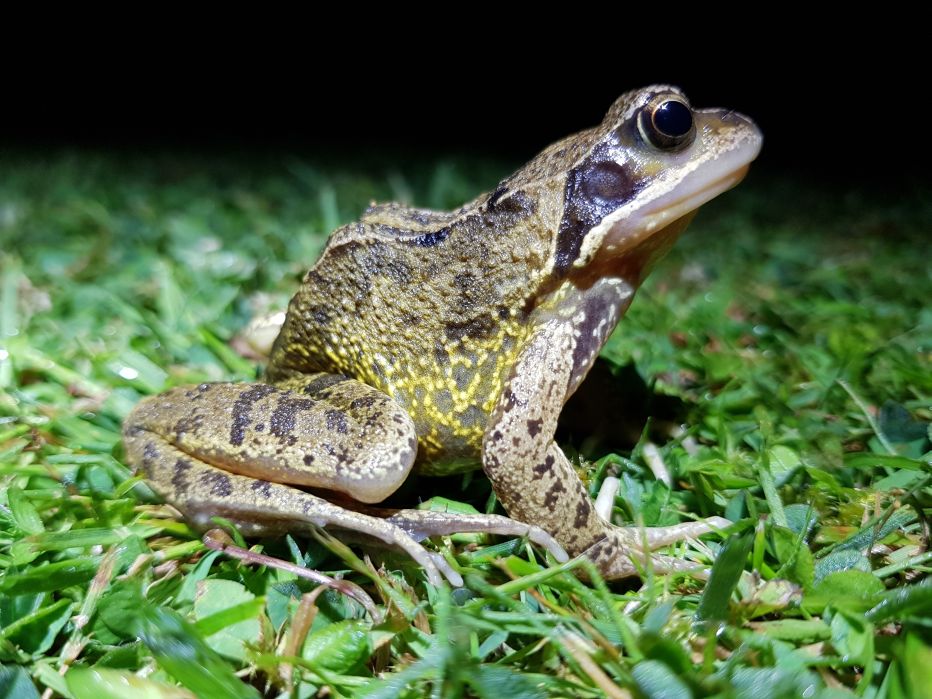
Common Frog © Dave Green
Comments
Very informative, great reading, thank you.
12 Jun 2020 10:40:30