
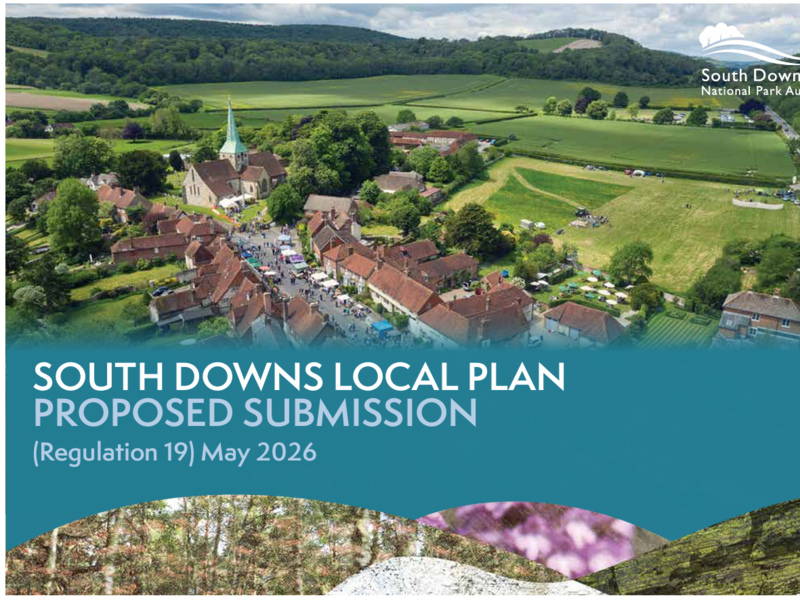
South Downs Local Plan - one week to go to have your say
Jess Price
Conservation Officer
Nature positive development can help address the climate and nature crises, as well as delivering much needed housing for people. But done badly, development can cause serious harm to wildlife and exacerbate climate change. We want to see plan-led strategic development that creates positive outcomes for people and nature, but in Sussex this hasn't been happening. We are seeing car-dependent housing built where there isn't enough clean water, sewage is already leaking into our environment and nature is fragmented with our most precious areas for wildlife getting squeezed. Local Authorities are scrabbling to get new local plans adopted that set a limit on development, but are fighting an uphill battle against national policy that sets the number of homes delivered above all other considerations.
In this context, it is so refreshing to read a draft local plan that has nature recovery at its core. As the introduction of the plan states 'The goal is to grow sustainably and regeneratively within the context and capacity of the landscape – so that both people and nature can flourish together'.
No local plan is perfect and there are certainly some proposed allocations within the plan that are of concern to local residents and ourselves. However, the SDNPA is showing real ambition in the local plan policies requiring a minimum of 20 or 33% Biodiversity Net Gain, rather than the statutory minimum of 10%. Safeguarding dark skies and locally designated wildlife sites. Championing nature-based solutions to protect and enhance the water environment and pioneering concepts such as regenerative development and nature and place-based design. This is a breath of fresh air compared to other local plans that regularly promote development on locally designated wildlife sites and struggle to include any nature positive policies.
The SDNPA does of course have a huge advantage, it is not under the same pressure as all other local authorities to deliver housing. In fact the National Planning Policy Framework states that the scale and extent of development with National Parks should be limited, giving the SDNPA an opportunity to do more. As the local plan states - the primary statutory purpose of the South Downs National Park is to conserve and enhance the natural beauty, wildlife and cultural heritage of its area, and regenerating its landscapes, nature and ecosystems is fundamental to achieving that purpose. If not in a National Park, then where can we pioneer these concepts in the planning system?
And we desperately need these concepts. As one of the most nature-depleted countries in the world, we need a planning system and local plans that help restore nature and create places that help people to thrive.
Sussex Wildlife Trust will be submitting a response to this consultation, supporting the most ambitious policies for nature and asking for amendments where we think things can be improved. We encourage you to get involved too.
This is the final consultation before the local plan is submitted to the Planning Inspectorate for independent examination. It differs from previous consultations on the new Local Plan, as the Planning Inspector will be interested in comments related to the Local Plan’s soundness and legal compliance, which means responses have to be much more limited in their scope.
The SDNPA have produced guidance on what this means.
Respond using the consultation platform by Tuesday 23rd June (closing at 23.59)
Comments
Please stop any plans to build on greenfield sites, farmland and nature reserves. I have recently had sign quite a few petitions against this type of action and find it alarming, especially when there are so many brownfield and grey field sites that are left unused and that have been that way for many many years. Choosing not to build on brown/grey field sites is grossly irresponsible. We are down to just 1% of chalk heath land on the Southdowns and most of what has been lost has happened in the last 80 years alone! As one of the most nature depleted countries in the world we have to do better, a lot better. We share this land with nature, SHARE IT, our actions, behaviour and attitudes must reflect and understanding and respect for that.
19 Jun 2026 11:14:00
Why is there so much ‘permitted’ development in the south east area, when there is a continuous problem with the supply of water & sewage removal? It is only going to get much worse if climate change is happening. Are the developers and planners blind to what is happening around them? Even the water companies, as useless as they are, state that they will not be able to supply demand if housing developments continue to increase unhindered. ITS TIME WE WOKE UP TO WHAT IS HAPPENING AND REALISE THE CONSEQUENCES OF CONTINUOUS DEVELOPMENTS.
19 Jun 2026 11:18:00
Totally agree with the two comments below from David and Dik.
Something I am very passionate about is the failure to allocate brownfield sites for housing. Government enforcement on owners of property left abandoned and boarded up in town centres, in particular, needs to step up and become effective. It’s currently ineffective and a shambles. Leave the farmland and greenfields alone, it’s unnecessary and has negative consequences for us all, human, animal and plant life.
19 Jun 2026 15:02:00
I am concerned about the proposed housing development in West Sussex under the South Downs Local Plan, as the area is already struggling with heavy traffic and insufficient infrastructure, which will only worsen with further expansion.
There are also ongoing risks of water shortages in this region, and increasing the population without a clear, sustainable supply raises serious concerns.
In addition, building on green spaces will have a significant impact on wildlife, leading to the loss of natural habitats and disrupting ecosystems that many species depend on for survival.
This reduction in biodiversity, combined with increased development, contributes to climate change and risks turning valued countryside into overdeveloped urban landscapes. Overall, the scale of development feels unsustainable and places excessive strain on both natural resources and the quality of life for existing residents.
24 Jun 2026 09:16:00